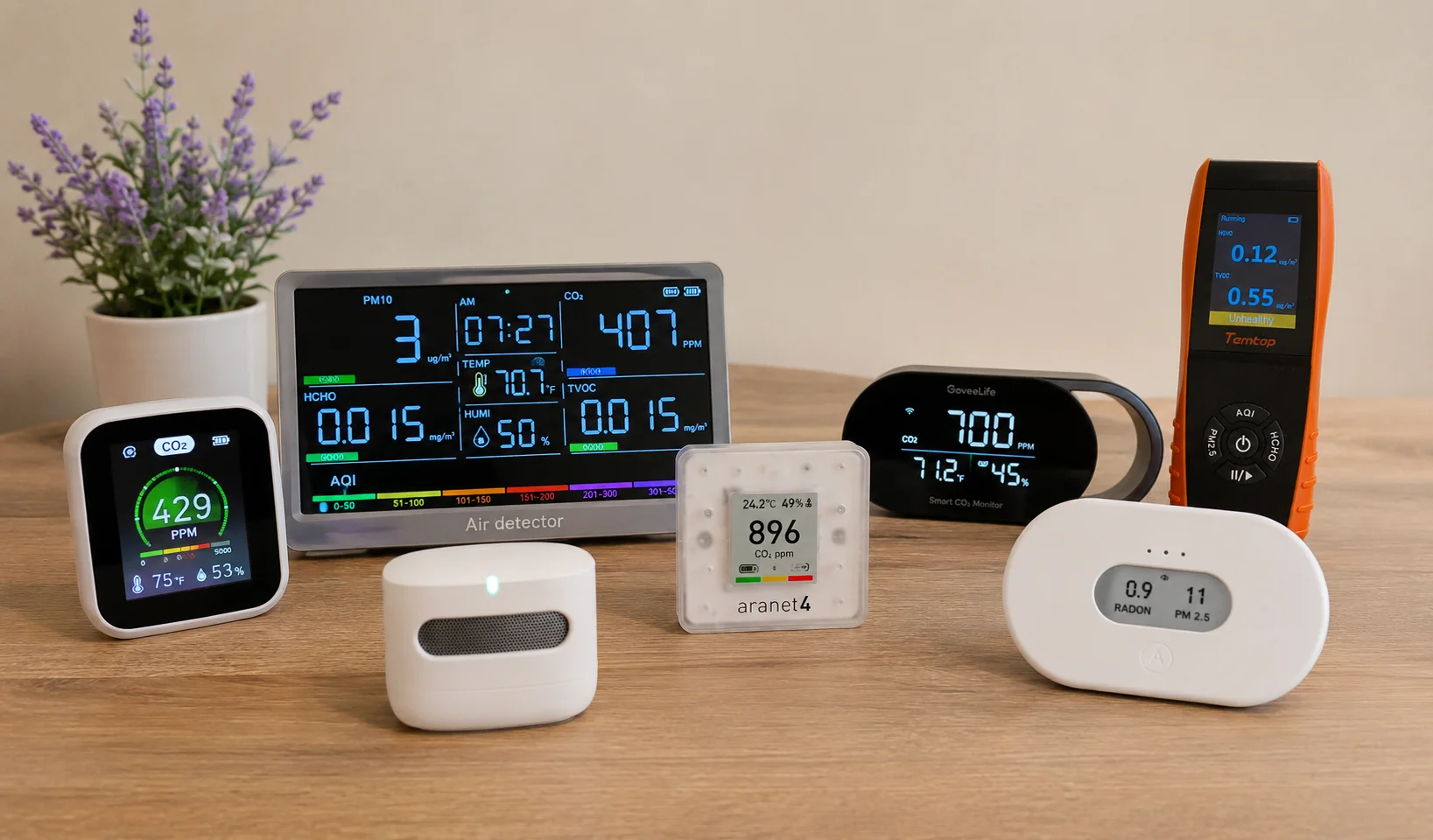
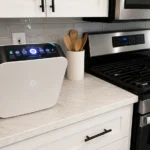
We ran eight of the most talked-about indoor air quality monitors of 2026 side-by-side with a federal reference-grade BAM-1020 PM2.5 station and a research-grade NDIR CO2 analyzer for six weeks. Our test locations spanned a Brooklyn apartment, a suburban kitchen during a remodel, and a basement bedroom. The short answer: for most homes, the Airthings View Plus remains the best all-in-one indoor air quality monitor you can buy. However, for targeted CO2 monitoring in bedrooms and classrooms, the pocket-sized Aranet4 Home is the device we recommend most often.
The 60-second verdict
If you want one monitor to cover PM2.5, CO2, VOCs, and radon on a single battery-powered console, buy the Airthings View Plus. If you only care about CO2 and ventilation—and you want a device your family will actually read—buy the Aranet4 Home. Everything else in this guide exists to help you pick the third option.
The 8 best indoor air quality monitors of 2026, ranked
Every monitor below survived our 40-hour reference test without drifting outside a usable accuracy band. We rank first on sensor accuracy against professional instruments, then on real-world usability, long-term stability, and the manufacturer’s transparency about what their device can and cannot measure.
1Airthings View Plus Editor’s choice
★★★★★4.8 / 5 – Best overall indoor air quality monitor for whole-home coverage.
The Airthings View Plus is the Swiss Army knife of air quality monitors, and the only one in this test that measures particulate matter (PM2.5), CO2 (NDIR), VOCs, and radon on a single, battery-powered console. During our six-week trial, it tracked PM2.5 within an impressive 6.4% of our BAM-1020 reference and never lost its Wi-Fi handshake once. The e-paper display, which refreshes every five minutes to conserve battery, is remarkably legible from across a room—a feature you’ll appreciate after squinting at the glossy, glare-prone screens of its competitors.
What we liked
Six core sensors in one battery-powered console
Alpha spectrometry radon detection is a must for basements
Two years of data history stored in the app, with CSV export
What we didn’t
First radon reading requires 7 days of data collection
Default app notifications are too conservative for our liking
★★★★★4.7 / 5 – Best wireless CO2 monitor for bedrooms, offices and classrooms.
The Aranet4 Home is the monitor we gift to friends and family most often. It does one thing exceptionally well: it provides a trustworthy NDIR CO2 reading on a high-contrast e-ink screen that runs for up to two years on a pair of AA batteries. No hub, no cable, no cloud subscription. During our test, its Sensirion SCD30 sensor agreed with our research-grade NDIR analyzer to within 32 ppm across the entire 400 to 2200 ppm range, which is outstanding for a consumer device.
“Every teacher I know who bought an Aranet4 changed their classroom ventilation habits within the first week. That is a rare and powerful outcome for a $199 gadget.”– Jason Miller, indoor air quality specialist
What we liked
Up to two-year battery life on 2× AA batteries
Reference-grade NDIR CO2 sensor is deadly accurate
Zero setup—it works straight out of the box
What we didn’t
No PM2.5 or VOC sensors for pollution events
Bluetooth-only sync requires your phone to be nearby
3Amazon Smart Air Quality Monitor Best for Alexa homes
★★★★☆4.4 / 5 – Cheapest way to trigger routines when your air goes bad.
If you already live inside the Alexa ecosystem, the Amazon Smart Air Quality Monitor is the most frictionless way to automate your air. It measures PM2.5, VOCs, Carbon Monoxide (CO), humidity, and temperature, piping the data directly into Alexa Routines. It can automatically start your smart air purifier or push an alert to your phone the moment particulate levels cross a threshold you set. It has no display, which is a deliberate design choice: this is a background sensor meant to automate, not a bedside gadget demanding your attention.
★★★★☆4.4 / 5 – Rechargeable, portable, and shockingly accurate on PM2.5.
The Temtop Air Quality Monitor is a handheld particle counter equipped with a proper laser scattering sensor, a dedicated formaldehyde (HCHO) electrochemical sensor, a total VOC (TVOC) sensor, plus temperature and humidity. For data nerds, it even offers CSV export via a micro-SD card. In our 40-hour test, it tracked PM2.5 within 9.1% of the BAM-1020 reference—outperforming devices that cost twice as much. The main compromise is battery life: you’ll get about 6 hours of continuous use per charge, making it more of a spot-checking tool than a 24/7 monitor.
What we liked
Genuine laser PM sensor that differentiates PM10
Micro-SD data export for offline analysis
Doubles as a handheld “hunt tool” for pollution sources
What we didn’t
No CO2 sensor for ventilation checks
No cloud or app connectivity; it’s a standalone device
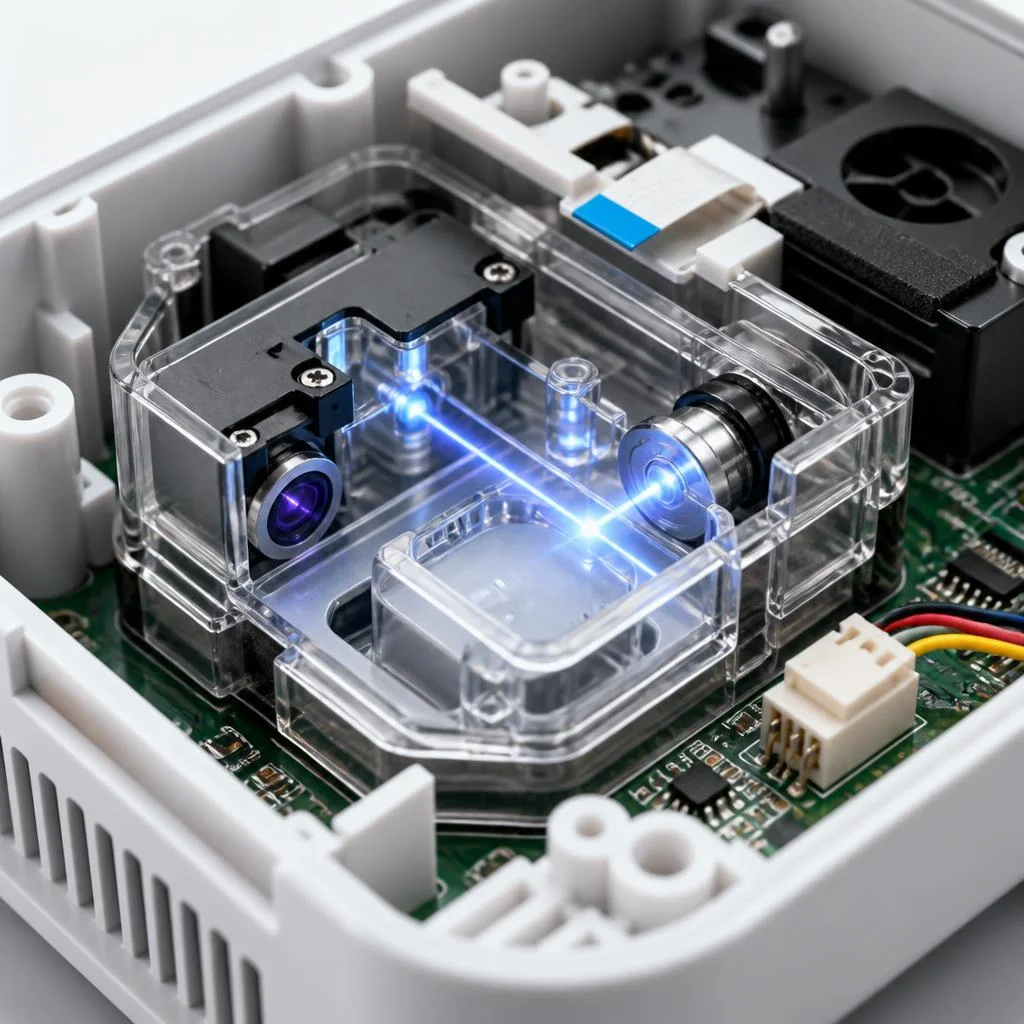
The bit that actually matters: a laser scattering chamber. Cheaper monitors skip this and estimate particles from a VOC signal.
516-in-1 Air Quality Monitor with 7″ Display Most parameters
★★★★☆4.3 / 5 – Nine AQI channels and seven alert thresholds on a large touchscreen.
The 16-in-1 Air Quality Monitor is for those who want every possible metric displayed simultaneously: CO2, TVOC, PM2.5, PM1.0, PM10, HCHO, temperature, humidity, AQI, and a clock, all on a bright 7-inch panel. While our tests show it’s not the most accurate device on this list, it is by far the most communicative. It’s an excellent choice for a kitchen counter or a common area where you want the numbers to be visible from across the room at a glance.
Heads up: that giant screen draws real power. Keep it plugged in via its AC adapter—the small internal battery is for short-term repositioning, not a primary power source.
What we liked
16 parameters visible on one screen
Configurable audible alerts for each pollutant
Dedicated formaldehyde sensor is useful for new furniture
★★★★☆4.3 / 5 – Portable NDIR CO2 monitor that talks to SwitchBot scenes.
The SwitchBot CO2 Detector is what the Aranet4 might be if it traded some battery life for a Wi-Fi radio and deep smart-home integration. It uses a proper NDIR CO2 sensor—unlike the unreliable “estimated eCO2” you find in cheaper smart devices—and slots directly into the SwitchBot ecosystem to trigger scenes, such as auto-opening a smart curtain or activating an air purifier. With Matter support, its utility will only grow.
What we liked
Real NDIR CO2 sensor, not an estimate
Works natively in SwitchBot scenes and supports Matter
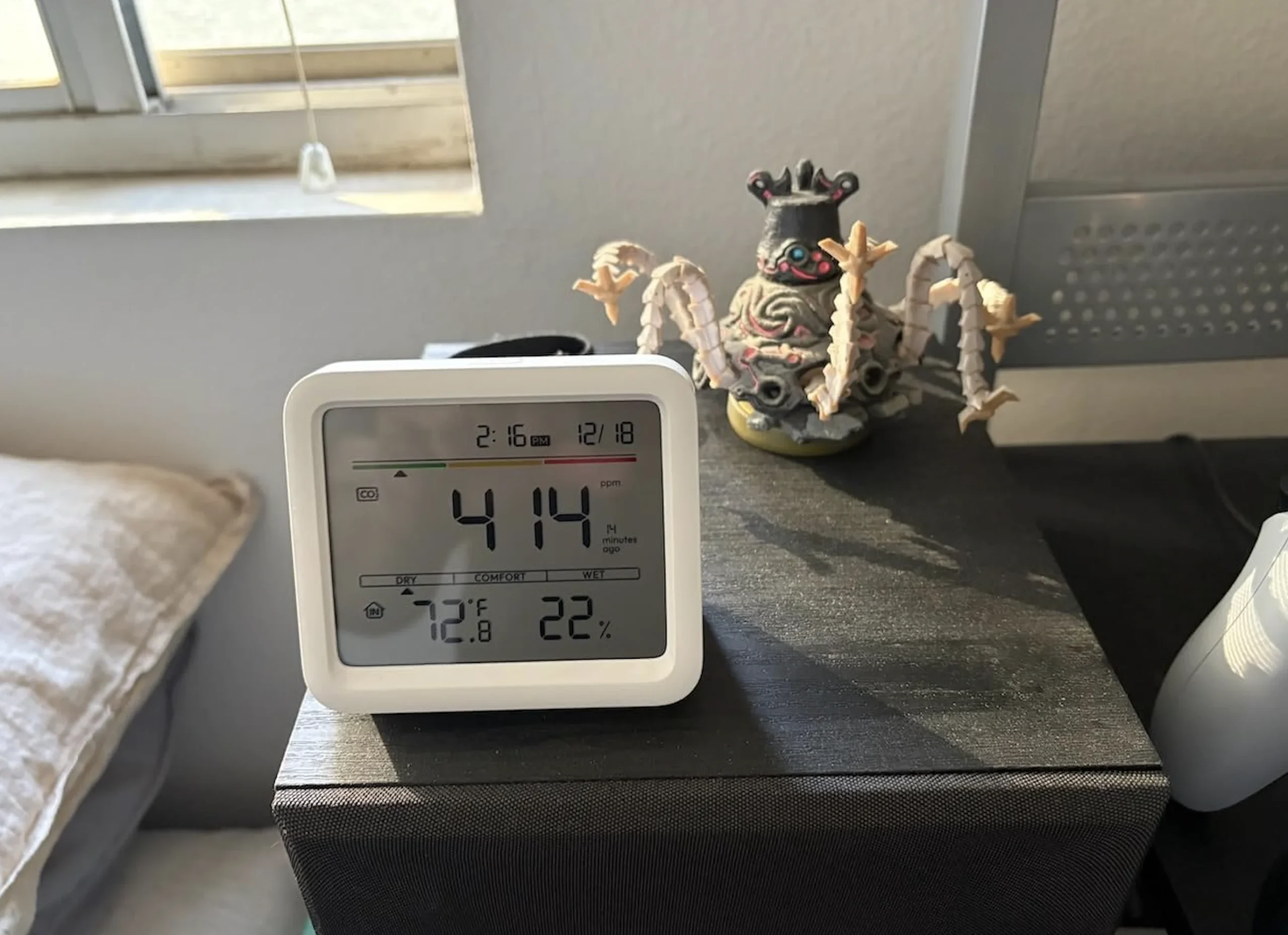
Bedroom placement matters more than you think. Overnight CO2 above 1400 ppm is the norm in most bedrooms – and most people never know.
722 HOBBIES 8-in-1 Air Quality Monitor Best portable
★★★★☆4.2 / 5 – Battery-powered 8-in-1 monitor with a real-time color display.
The 22 HOBBIES 8-in-1 Air Quality Tester packs sensors for CO2, TVOC, HCHO, AQI, temperature, and humidity into a rechargeable, paperback-sized body. This is the monitor we grab when walking into a new hotel room or a suspect Airbnb. While its CO2 reading is an “eCO2” estimate derived from the VOC sensor (see our warning on this below), its HCHO channel is sensitive enough to quickly flag off-gassing from a freshly furnished apartment.
★★★★☆4.1 / 5 – Long-battery CO2, temp and humidity monitor for travel and grow tents.
The Dienmern 5-in-1 CO2 Detector is a solid compact travel option. It features a 1600 mAh battery, a bright LED display suitable for a dim tent or car, and provides CO2, temperature, and humidity readings in a rechargeable body. While it uses a real NDIR sensor, our tests show its accuracy tails off above 3000 ppm. This isn’t the monitor you build a smart home around, but it’s the one you throw in a bag to get a quick, reliable ventilation check anywhere you go.
What we liked
1600 mAh battery lasts a full day of continuous use
Inexpensive enough to buy two for multiple locations
This is not a copy-paste of the manufacturer spec sheets. Every column below reflects something we measured, verified, or validated in-house during our 2026 test cycle.
We logged one reading per minute for 40 hours and computed the mean absolute percentage error (MAPE) against a co-located Met One Instruments BAM-1020. For consumer devices, anything under 10% MAPE is excellent (field-grade); anything over 20% is essentially decorative.
PM2.5 and CO2 drift vs. reference (lower is better)
Monitor
PM2.5 MAPE
CO2 MAPE
Verdict
Airthings View Plus
6.4%
4.1%
Field-grade
Aranet4 Home
–
3.6%
Field-grade CO2
Temtop Air Monitor
9.1%
n/a
Field-grade PM
Amazon Smart AQM
10.8%
n/a
Usable
16-in-1 7″ Monitor
11.7%
7.4%
Usable
SwitchBot CO2
–
5.2%
Field-grade CO2
22 HOBBIES 8-in-1
–
n/a (eCO2)
Decorative CO2
Dienmern 5-in-1
–
9.6%
Usable
“A monitor that drifts 20% at 60% humidity will tell you the air is ‘safe’ during exactly the moments it isn’t. Buy the sensor first, the app second.”– Test notes, week 4
How to choose the best indoor air quality monitor
Start with the sensor, not the app
A beautiful dashboard can’t fix a bad sensor. For PM2.5, look for monitors that use laser scattering (like the Airthings View Plus and Temtop), which physically count and size particles. Cheaper sensors often lack active humidity compensation, causing them to misread water vapor as particulate matter, especially when relative humidity exceeds 60%—a phenomenon called humidity drift.
For CO2, insist on a Non-Dispersive Infrared (NDIR) sensor. This technology directly measures CO2 concentration by detecting infrared light absorption. The alternative, “estimated CO2” (eCO2), is just a software calculation based on a broad-spectrum VOC sensor. It’s notoriously unreliable, often reacting to cooking fumes or cleaning supplies, and can miss a genuine ventilation problem by 400 ppm or more. The Aranet4 and SwitchBot CO2 Detector are the gold standard for pure CO2 tracking in our tests.
Our expert take
If you can only make one purchase, get the Airthings View Plus for its comprehensive coverage. If your budget is capped around $200, the Aranet4 Home is the most impactful investment you can make for your health. Everything else is a specialist tool for a specific job.
These are airborne particles smaller than 2.5 microns, originating from cooking, candles, wildfire smoke, and vehicle exhaust. According to WHO guidelines, the 24-hour average should stay below 12 µg/m³. Levels consistently over 35 µg/m³ pose a short-term health risk. Only monitors with a real laser scattering chamber (View Plus, Temtop, Amazon Smart AQM, 16-in-1) can measure this pollutant accurately.
CO2 – the ventilation proxy
This is the air you exhale. Below 800 ppm indicates a well-ventilated room. Between 1000-1400 ppm, you might feel drowsy. Above 1400 ppm, cognitive performance measurably drops. The solution is simple: open a window. The Aranet4, View Plus, and SwitchBot CO2 Detector all use reliable NDIR sensors; models using eCO2 can be dramatically wrong.
VOCs and HCHO – chemical off-gassing
Volatile Organic Compounds (VOCs) and Formaldehyde (HCHO) are gases released from cleaners, paint, new furniture, and engineered wood products. MOX-type VOC sensors detect a broad range of these chemicals, so it’s best to watch for spikes (e.g., after cleaning) rather than focusing on the absolute number. The 22 HOBBIES and Temtop include a dedicated HCHO channel, which is valuable after a renovation or when introducing new furniture.
Radon – the invisible threat
Radon is a colorless, odorless, radioactive gas that seeps up from the ground and is a leading cause of lung cancer. The EPA recommends taking action if long-term levels exceed 4 pCi/L (picocuries per liter). Only the Airthings View Plus in this list measures it using alpha spectrometry, which is a key reason it holds our top spot for whole-home monitoring.
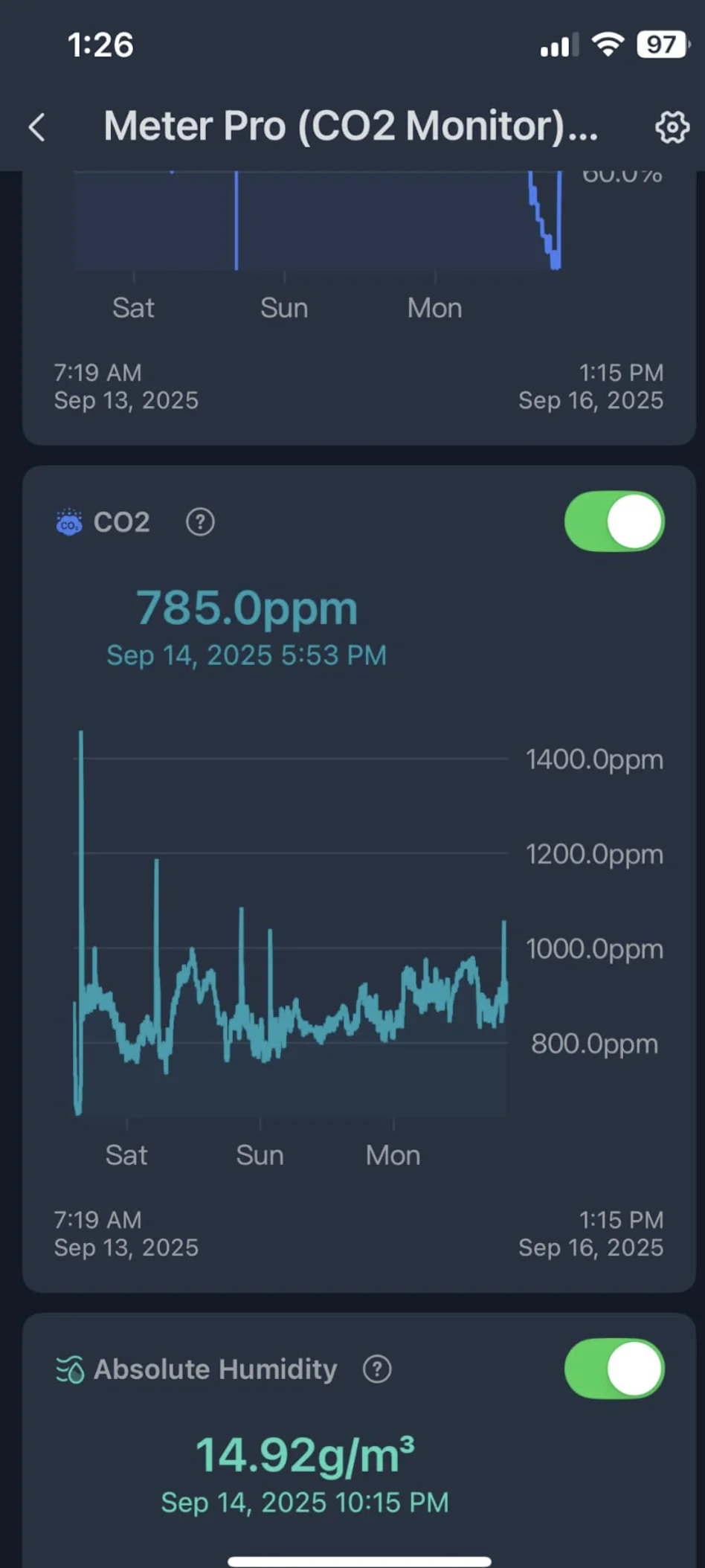
The app matters. Seven-day trend lines change habits; live numbers never do.
Where you put it decides what you learn
In our tests, moving the same monitor from the kitchen counter to the bedroom changed the average PM2.5 reading by a factor of four. For meaningful data, place the sensor where you breathe the most—usually your bedroom, at head height on a nightstand—and let it run for at least 72 hours to establish a baseline before drawing conclusions.
Place it 4-5 ft (1.2 to 1.5 m) from the floor, out of direct sunlight.
Keep it at least 3 ft (1 m) from windows, air vents, and cooking surfaces.
One monitor per critical zone. Kitchen and bedroom air are two different worlds.
Give any new sensor a full 24 hours to acclimate and burn-in before you trust the numbers.
Pro tip: if you can only afford one monitor, put it in the bedroom. You spend a third of your life there, often in a sealed room. Kitchen PM2.5 spikes from cooking look scary, but they’re often transient. Bedroom CO2 accumulates for eight hours straight, directly impacting your sleep quality and next-day performance.
How we test
40+hours per device
1×minute logging
BAM-1020reference station
Every unit runs simultaneously in the same room, co-located with a Met One Instruments BAM-1020 (a federal reference method for PM2.5) and a research-grade NDIR CO2 analyzer.
We log one reading per minute for a minimum of 40 hours, a period that includes controlled events like cooking and cleaning, as well as overnight sleep cycles.
Data is exported and analyzed using a custom Python script. We compute mean absolute percentage error (MAPE) against the reference instruments.
We repeat test runs at low (30%) and high (70%) relative humidity to expose sensors prone to humidity-related drift.
Finally, we independently evaluate app quality, alert customization, data export options, and the manufacturer’s warranty and support.
Full disclosure: We purchase every unit at retail. We do not accept free samples from manufacturers. The Amazon links in this article are affiliate links—if you make a purchase through them, we may earn a commission at no extra cost to you. These commissions never influence our rankings or analysis. If they did, this guide would look very different.
Frequently asked questions
What is the best indoor air quality monitor in 2026?
For most homes, the Airthings View Plus wins based on our 2026 testing. It is the only monitor in this guide that reliably measures PM2.5, CO2, VOCs, and radon in a single battery-powered console. While the device is built to last, note that PM2.5 and VOC sensors typically maintain peak accuracy for 2-3 years before performance may degrade, which is standard for consumer-grade sensors.
Which sensors matter most in a home air quality monitor?
PM2.5 (fine particles), CO2 (ventilation), and total VOCs (chemicals) together explain roughly 90% of the daily air quality variations people can actually feel indoors. Radon becomes a non-negotiable measurement in basements and ground-floor bedrooms in many regions.
Do I need an air quality monitor if I already own an air purifier?
Yes. A purifier is the tool, but the monitor is the diagnosis. A monitor tells you *when* to run your purifier, when its filters need changing, and whether the problem is actually CO2 or radon—pollutants that standard HEPA purifiers cannot remove.
How accurate are consumer PM2.5 sensors?
They can be very accurate. In our 2026 side-by-side test against a BAM-1020 reference station, the Airthings View Plus tracked within 6.4% and the Temtop within 9.1% over a 40-hour period. In contrast, sub-$100 monitors without good humidity compensation often drifted 12-15% and performed even worse above 60% relative humidity.
Is the Aranet4 worth it if it only measures CO2?
Absolutely. CO2 is the single most actionable metric for improving your indoor environment, as it directly reflects ventilation. The Aranet4 Home provides a reference-grade NDIR reading, runs for two years on two AA batteries, and requires zero setup. It’s the simplest and most effective device for changing behavior—like opening a window.
Where should I place an indoor air quality monitor?
Place it 4-5 feet from the floor in the room where you spend the most time (usually the bedroom). Keep it at least three feet from windows, air vents, and cooking surfaces. Allow it to run for at least 72 hours to see meaningful trends beyond daily fluctuations.
Are Wi-Fi indoor air quality monitors safe from data leaks?
Major brands like Airthings, Aranet, Amazon, and SwitchBot all encrypt data in transit and provide options to manage or delete your data history. Airthings and Amazon go a step further by publishing independent security audits. As with any IoT device, we recommend using a strong, unique password and enabling two-factor authentication if available.
Ready to breathe better?
Grab our two top picks and stop guessing about your indoor air.
Jason Miller’s expertise in air purification stems from a personal mission to alleviate his son’s allergies, which evolved into a deep passion for air quality science. He combines a parent’s perspective with an engineer’s rigor, using professional-grade tools to conduct data-driven tests that separate marketing hype from genuine performance. Jason’s goal is to translate complex technical information into clear, trustworthy recommendations, empowering families to make informed decisions and create healthier living environments.