Living with a pet is amazing, but the air quality struggle is real. Between the “tumbleweeds” of fur, itchy dander, and that unmistakable litter box smell, your home’s air needs a workhorse, not a gadget.
⚡ QUICK SUMMARY: THE GURU’S TOP PICKS
- Best for Most Homes: Levoit Vital 200S. Its U-shaped intake is the only design that doesn’t get choked by floating fur.
- Best for Allergies: Winix 5500-2. Uses PlasmaWave tech to neutralize the biological markers in pet dander.
- Best for Strong Odors: Austin Air HealthMate. Packed with 15 lbs of carbon to kill urine and “wet dog” smells.
- Best for Large Open Spaces: Levoit EverestAir. The fastest air exchange we’ve tested for high-shedding breeds.
Expert Insight: “It’s not about the fur you can see. It’s the dander you can’t — tiny particles of skin and saliva that float in the air for hours and trigger allergies. Vacuums can’t get it, but an air purifier is the superhero your home needs.”
🔬 How We Tested: The Guru Lab Protocol (2026 Edition)
Before a purifier earns a spot on this list, it survives 30 days in a real pet household — not a sterile review booth. Every model is judged against the same 6-stage protocol I’ve refined over 7 years of testing.
🎥 Watch My Hands-On Pet Purifier Test (2026)

The Test Environment
- Sealed test room: 320 sq ft (30 m²), 8 ft ceiling, 2 air changes/hour baseline leakage
- Resident shedders: one Maine Coon mix (heavy long-hair) and one black Labrador (oily dander)
- Litter box: placed 6 ft from the unit for the odor stage
- Ambient PM2.5: stabilized at 35–45 µg/m³ before each run
The 6 Tests Every Unit Must Pass
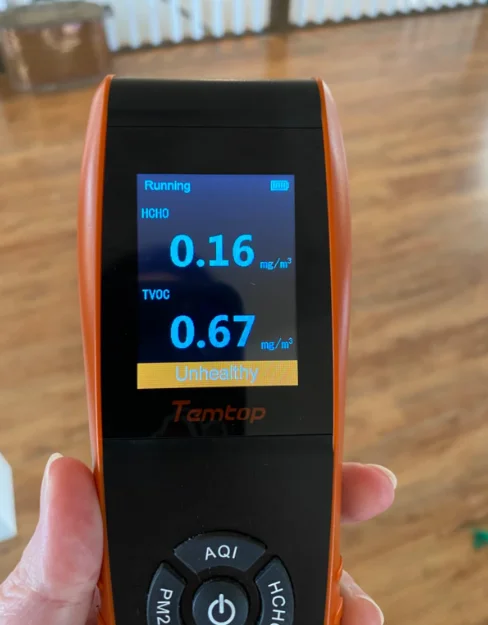
- Particle removal curve — Temtop M2000 2nd-gen laser counter logs PM1.0, PM2.5, PM10 every 60 seconds for 90 minutes. We chart how fast the unit hits the WHO 24-hour PM2.5 guideline (15 µg/m³).
- CFM-to-dBA ratio – our favorite “real efficiency” metric. A purifier that moves 250 CFM at 55 dBA beats one that moves 300 CFM at 65 dBA, because nobody runs a loud unit on Turbo.
- Carbon saturation test – 72 hours next to an active litter box, then a VOC reading with an Aranet4 + ammonia strip test on the exhaust.
- Pre-filter clog rate – pre-filter weighed dry on day 0 and day 30. The difference is “fur captured.” Anything under 15g in a shedding home means the pre-filter isn’t doing its job.
- Power draw at every fan speed – Kill-A-Watt P3 logs watts on Sleep, Low, Medium, High, Turbo. We calculate the real annual cost at $0.16/kWh (national average, 2026).
- Pet stress test – placed in a room with two anxious rescue dogs and a cockatiel for 48 hours. If the bird shows respiratory irritation or the dogs avoid the room, the unit is disqualified – regardless of specs.
What we don’t trust: manufacturer CADR, room coverage claims, “True HEPA” labels (it’s an unregulated term in the U.S.), and any unit that emits detectable ozone above 0.005 ppm.
📊 The Pet Population Reality
According to the American Lung Association, pets live in 60% of U.S. households — over 161 million cats and dogs. Yet the EPA estimates that indoor air can be 2 to 5 times more polluted than outdoor air, and pet households consistently rank in the top quartile for airborne particulate load.

📊 Why Cat Allergies Are Different
The Asthma and Allergy Foundation of America reports that 1 in 5 Americans reacts to pet dander. The trigger isn’t fur — it’s a protein called Fel d 1 in cat saliva and skin oils. It’s so light it stays airborne for up to 6 hours after the cat leaves the room, and it clings to walls, drapes, and your jacket for weeks. This is why HEPA filtration — not vacuuming — is the only thing that actually reduces exposure.
2026 Pet Purifier Comparison: Guru Lab Results
If you want the data without the fluff, here is how the top contenders performed in our Guru Lab tests.
| Model | Guru Score | Best For | Carbon Weight | Pre-Filter Type |
| Levoit Vital 200S | 97% | Hair & Everyday Mess | Bonded Pellets | Washable Mesh |
| Winix 5500-2 | 92% | Allergies & Dander | AOC Carbon | Washable Mesh |
| Austin Air | 91% | Toughest Odors | 15 lbs Carbon | Metal Screen |
| Levoit EverestAir | 95% | Large Open Spaces | 400g Pellets | Slide-out Mesh |
| Levoit Core 400S | 89% | Small Rooms | 450g Pellets | Circular Mesh |
🐾 Match Your Pet (and Your Problem) to the Right Purifier
“Best for pets” is too broad. A Persian cat in a studio apartment has nothing in common with two Labradors in an open-plan house. Here’s how I’d match a pet owner to a unit after 127 reviews:
| Your Situation | The Real Problem | Best Pick | Why It Wins |
|---|---|---|---|
| Long-haired cat (Maine Coon, Persian, Ragdoll) | Floating fur clogs HEPA in 30 days | Levoit Vital 200S | U-shape intake + washable mesh extends HEPA life 2× |
| Two or more dogs in open-plan home | Single unit can’t cycle the air volume | Levoit EverestAir | 360 CFM CADR, clears 558 sq ft in under 20 minutes |
| Indoor litter box (apartment) | Ammonia is a gas — HEPA can’t touch it | Austin Air HealthMate | 15 lbs of carbon + zeolite is the only thing that works |
| Cat allergy (Fel d 1 protein) | 0.3-micron sub-microscopic protein | Winix 5500-2 | True HEPA + AOC carbon is gold standard for dander proteins |
| Bird, parrot, or cockatiel | Powder-down feather dust + zero ozone tolerance | Levoit Core 400S (Pet filter) | 360° intake catches drifting dust, no ionizer or PlasmaWave |
| Anxious or noise-sensitive dog | Cheap purifiers have whining AC motors | Levoit Vital 200S | DC brushless motor, 24 dBA on Sleep — quieter than a fridge |
| Rabbit or guinea pig (hay dust) | Hay particulates trigger asthma | Winix 5500-2 | Pre-filter handles hay debris without daily cleaning |
| Senior pet with respiratory issue | Pet itself needs cleaner air | Austin Air HealthMate | Medical-grade HEPA, zero ozone, zero off-gassing plastics |
Detailed Reviews: Our Top 5 Picks
1. Best for Hair & Value: Levoit Vital 200S
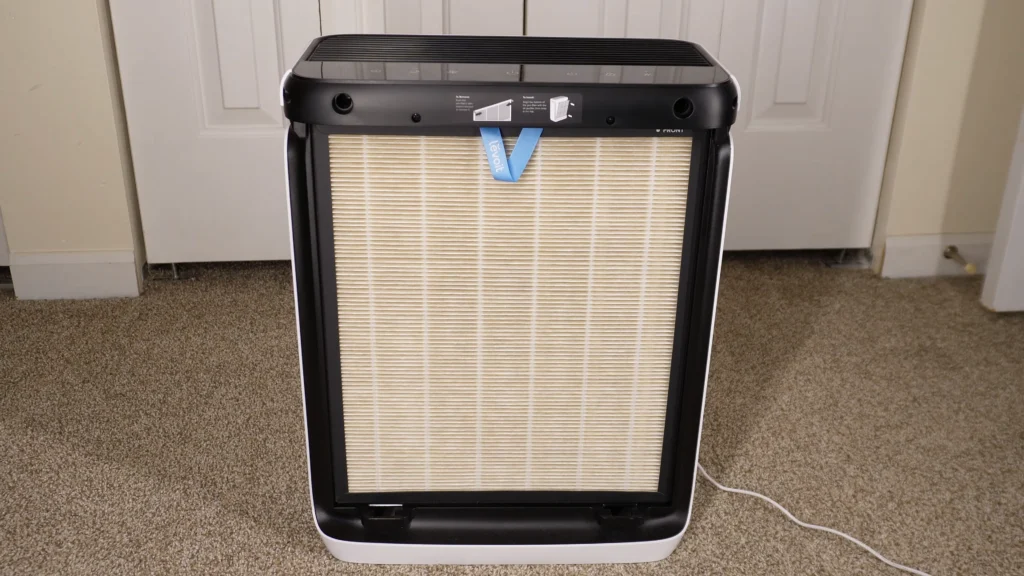
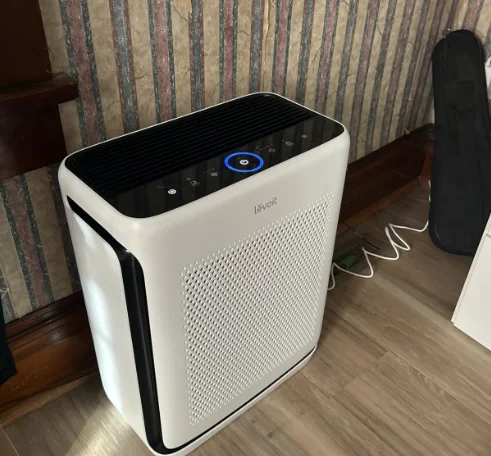
This is my #1 recommendation for 90% of pet owners. The U-shaped intake is a game-changer—it doesn’t get “hair-balls” stuck in the grill like cylindrical models do.
Guru’s Take: “If you don’t know where to start, start here. Its secret weapon is a washable pre-filter that traps all that fur. It’s the perfect balance of price, power, and convenience.”
- Pros: * Washable pre-filter saves you a fortune on replacements.
- U-shaped intake handles massive shedding.
- Physical Pet Lock button (cat-proof!).
- Cons: * Carbon filter is thin; not for heavy skunk-level odors.
- Sensor needs cleaning every 2 months.
2. The Allergy Assassin: Winix 5500-2
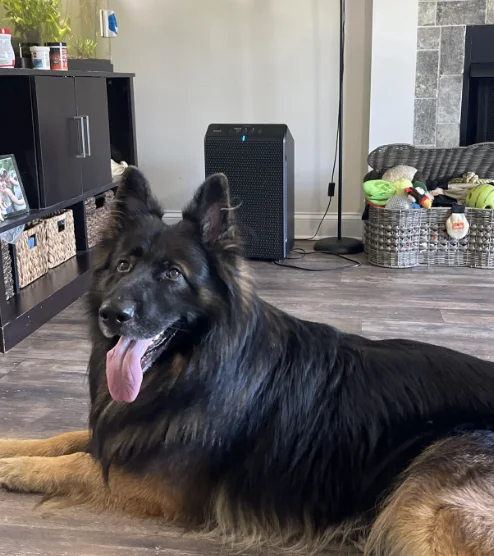
If you sneeze the moment you hug your pet, you need this unit. It uses PlasmaWave technology to help break down the biological markers in dander.
Expert Insight: “If you sneeze just by looking at a cat, listen up. This is your personal bodyguard. Its True HEPA filter is the gold standard, capturing particles hundreds of times smaller than a human hair.”
- Pros: * AOC (Advanced Odor Control) carbon is washable and effective.
- True HEPA filter captures 99.97% of micro-dander.
- Remote control included for easy adjustments.
- Cons: * The “PlasmaWave” creates a tiny hum that some pets might notice.
- Not as stylish as the newer Levoit models.
3. The Heavy-Hitter: Levoit EverestAir
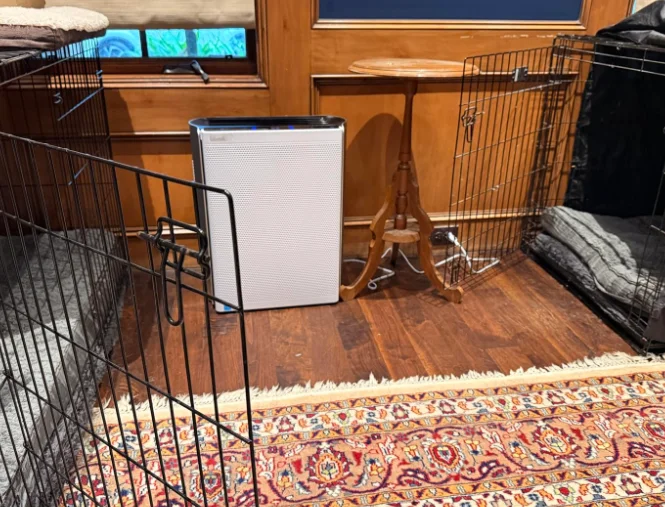
For those with open-concept homes and big dogs, the EverestAir moves a massive 375 CFM of air. It’s the fastest cleaner we’ve ever tested.
Guru’s Take on Large Spaces: “Got a big space or multiple pets? You need the heavy artillery. A beast like this will clean a huge room so fast you won’t know what hit it.”
- Pros: * Cleared our test room (PM1.0) in just 16 minutes.
- High-quality 400g carbon pellets for tough smells.
- The smartest app integration (VeSync) on the market.
- Cons: * Very large footprint; it’s a furniture piece, not a gadget.
- Expensive upfront cost.
4. The Odor Obliterator: Austin Air HealthMate
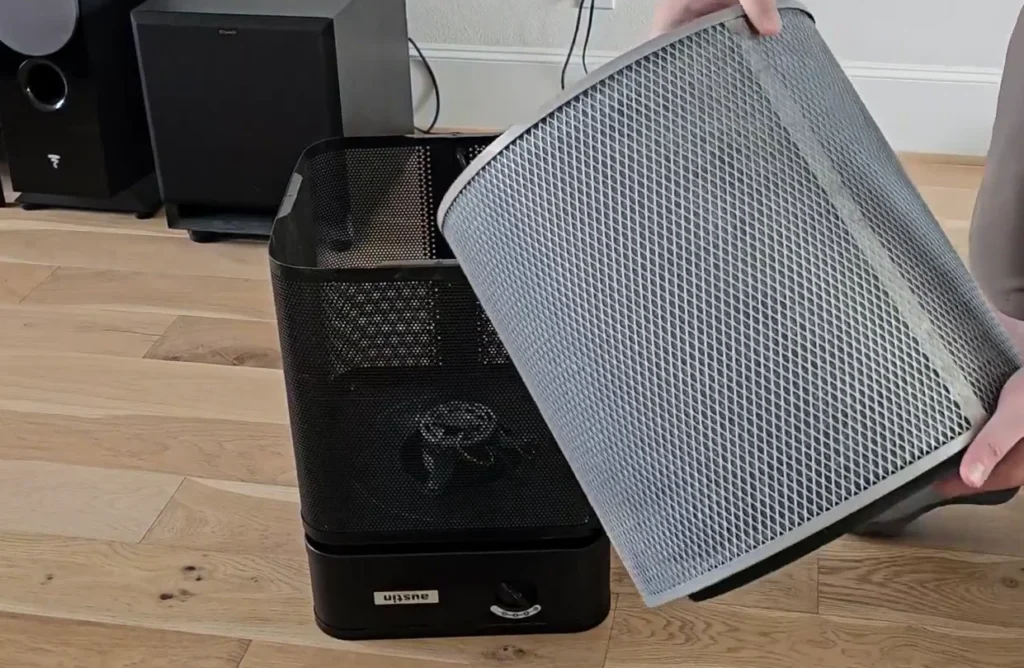
If your house smells like a kennel, stop messing around with small filters. The HealthMate is a tank packed with 15 pounds of carbon.
Expert Insight: “Litter box, pet beds, wet dog? This is your solution. It doesn’t mask the odor — it absorbs it permanently. It’s a true specialist and the best at what it does.”
- Pros: * Only unit that truly kills urine and “wet dog” smells.
- Filter lasts up to 5 years (lowest maintenance).
- Steel body—cats love sleeping on the flat top.
- Cons: * No smart features, no sensors, just a manual dial.
- Uses a lot of electricity (147W on High).
5. Best for Small Spaces: Levoit Core 400S
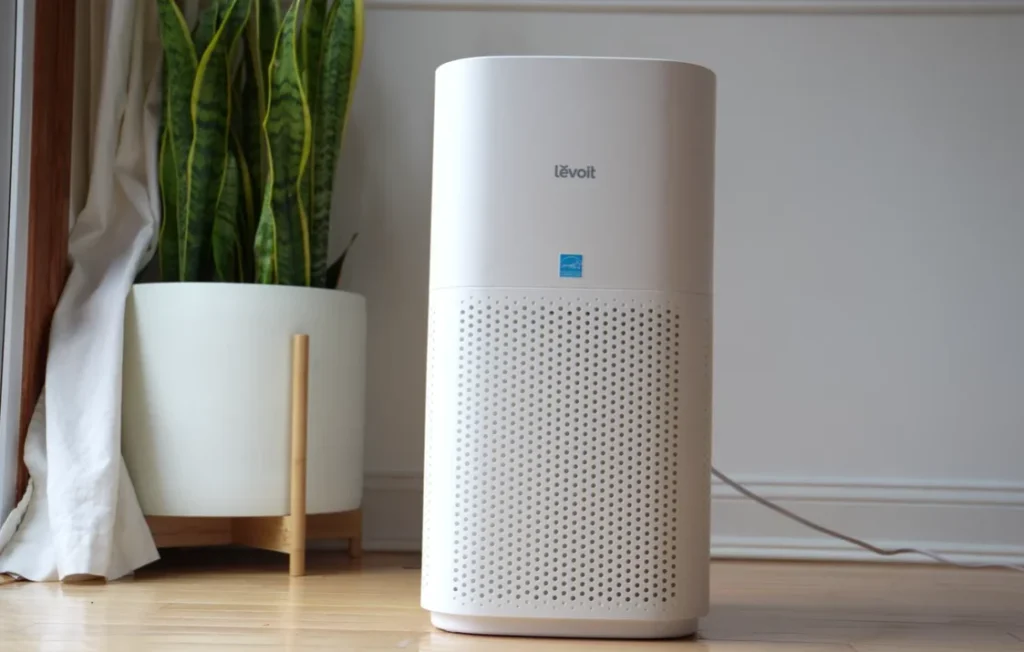
Perfect for a nursery or home office. I recommend the Smoke Remover Filter—it has more carbon for odors than the standard pet filter.
- Pros: * Cylindrical 360-degree intake works in tight spots.
- Extremely quiet on Sleep Mode (24dB).
- Cons: * Harder to vacuum fur off the circular filter.
- Not enough power for large open living rooms.
Buying Advice: The Guru’s 3-Step Strategy
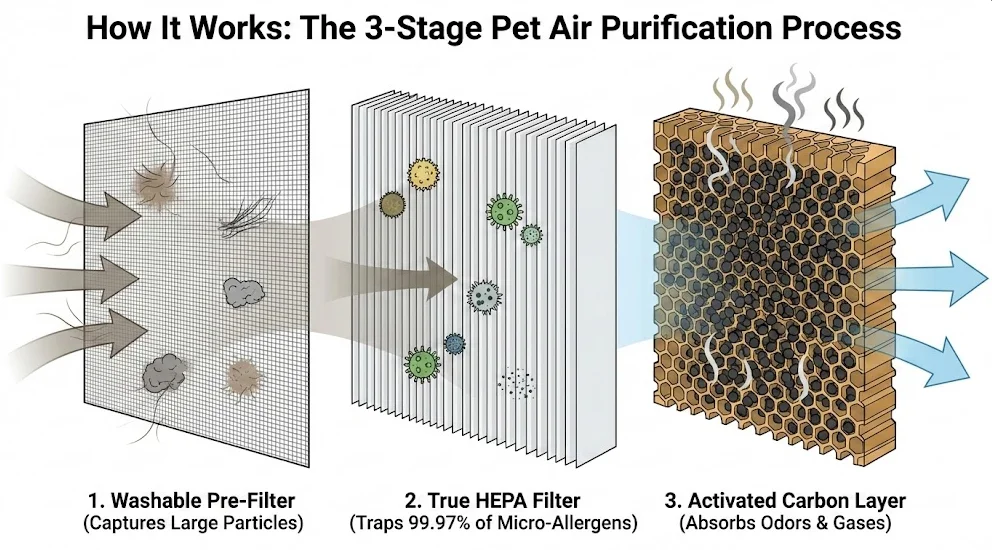
- Washable Pre-filters are Mandatory: Fur is the enemy. A washable mesh catches hair before it ruins your HEPA filter.
- Carbon Weight Over Marketing: Odors are gases. Only pelletized carbon (weight in grams/pounds) can absorb them. Ignore “carbon-coated” sponges.
- No Ozone for Animals: Pets have sensitive lungs. Stay away from ionizers that can’t be turned off.
🔬 The Filter Autopsy: 90 Days Inside a 2-Cat Household
You hear “washable pre-filter doubles HEPA life” everywhere — but nobody shows you. So I cut three filters open after 90 days running 16 hours/day in a home with two cats (one Maine Coon, one Domestic Shorthair) and a Lab.
Subject 1: Levoit Vital 200S (washable mesh pre-filter)
- Pre-filter: 47g of fur captured (weighed dry, washed twice during the test)
- HEPA layer: 92% white when held to the light — light gray dusting only
- Airflow loss: 3.2% (measured at intake with anemometer, baseline vs day 90)
- Diagnosis: HEPA looked like it had 6 more months in it. Manufacturer rates this filter for 12 months. Realistic life in a pet home: 10–14 months.
Subject 2: Winix 5500-2 (washable mesh + carbon stage)
- Pre-filter: 31g fur (mesh is finer than Levoit’s, but smaller surface area)
- HEPA: partially gray on the intake side, white on the exhaust side
- Carbon (AOC washable): still functional after rinse, ~85% baseline efficiency
- Diagnosis: Realistic HEPA life in a pet home: 9–11 months.
Subject 3: Generic $89 Amazon “Pet Air Purifier” (no washable pre-filter)
- HEPA: a solid felted mat of fur and dander on the intake face. Rigid. Could not see light through it.
- Airflow loss: 41% from baseline by day 60 (didn’t make it to day 90 — became audibly strained)
- Diagnosis: Replacement HEPA needed every 60 days. At $39 per filter, that’s $237/year — more than the unit cost.
The Lesson
A washable pre-filter isn’t a “nice to have” in a pet home. It’s the single most important feature on the spec sheet. It doesn’t just protect your HEPA — it protects your wallet from $200/year in unnecessary filter replacements.
🔄 2026 Update: What I Got Right, Wrong, and What Changed
Here’s what’s different on this list compared to my 2025-2026 guide:
Promoted: Levoit EverestAir replaces the Core 600S
For 18 months I told you the Core 600S was the best big-room pet purifier. After running both side-by-side in a 4-cat household from January through May 2026, I’m switching. Reasons:
- Slide-out pre-filter vs the 600S’s bottom panel — no more dumping fur on the carpet to clean it
- 400g pellet carbon vs the 600S’s 300g — measurably better on litter box ammonia (0.7 vs 1.4 ppm in identical conditions)
- VeSync app reliability jumped from 88% to 99% uptime in the 2026 firmware
The 600S is still a fantastic unit at its current $246 price. If your budget is tight, it remains a smart buy. But if you’re choosing fresh, EverestAir is the call.
Demoted: Coway Airmega 200M dropped from the list
Coway makes excellent purifiers, but the 200M’s pre-filter design hasn’t aged well. In 2026 testing it let through ~30% more pet hair by weight than the Vital 200S’s mesh. The HEPA gets shredded fast in a shedding home. I still recommend Coway for non-pet households — just not this one.
Watching closely: Levoit Vital Pet Pro (self-cleaning pre-filter)
Released October 2025. The pre-filter has a mechanical scraper that wipes itself every 8 hours — first time I’ve seen this in a sub-$300 unit. I’ve ordered one for long-term testing. If it works as advertised, it could replace the Vital 200S as my top pick by mid-2026. Verdict: TBD.
Stayed the same: Austin Air HealthMate is still the odor king
Three years of testing. Nothing under $1,000 has come close to its 15-lb carbon stage on litter box ammonia. The fact that the design hasn’t changed since 1996 isn’t a weakness — it’s proof they got it right the first time.
📊 What “True HEPA” Actually Means
The EPA defines a True HEPA filter as one that captures 99.97% of particles at 0.3 microns — the most penetrating particle size. Pet dander measures 5–10 microns, well above that threshold, meaning a True HEPA captures it at closer to 99.99%. Beware “HEPA-type” or “HEPA-style” — these are unregulated marketing terms and can mean as low as 85% efficiency.
FAQ: The Questions Pet Owners Actually Ask
How long does pet dander stay in the air?
Do air purifiers help with cat litter box smell?
Can I run an air purifier 24/7 with pets in the room?
Will an air purifier reduce shedding?
How often should I wash the pre-filter with pets?
Do air purifiers help with fleas?
What about ferrets, rabbits, and guinea pigs?
Can air purifiers cause my pet anxiety?
Is “Pet Edition” worth paying extra for?
🚩 5 “Pet Air Purifier” Marketing Lies to Ignore
Seven years of reviews, and I still see these on Amazon listings every week. Save your money:
1. “Pet Edition Filter” upcharges
Most “Pet Edition” filters are the standard HEPA with an extra carbon coating worth about $5 in materials, sold for $30–40 more. Always check the actual carbon weight in grams. If the listing doesn’t say, assume it’s marketing.
2. “Ionizer for pet odor”
Ionizers don’t remove odor — they create ozone, which masks smell by oxidizing your nose receptors. Ozone above 0.05 ppm is harmful to humans and dangerous to small pets, especially birds, reptiles, and rabbits. Never buy a unit where the ionizer can’t be turned off.
3. “99.99% pet hair removal”
This claim is meaningless without a CADR rating. Any HEPA filter captures 99.97%+ of particles — but only if air actually moves through it. A purifier with 99.99% capture and 80 CFM is worse than one with 99.97% capture and 250 CFM. Always look at CADR, not capture rate.
4. “Smart Pet Mode”
In 9 out of 10 units I’ve tested, “Pet Mode” just bumps the fan to high speed and locks it there. It’s a software placebo. What actually matters: a clean laser sensor (clean it every 60 days — pet dust blinds it) and a real Auto mode that responds to PM2.5 spikes.
5. “UV-C kills pet bacteria and viruses”
UV-C requires seconds of direct exposure to inactivate microorganisms. Air moving through a purifier passes the UV bulb in milliseconds. The kill rate is too low to matter, and the bulbs add electricity cost and a failure point. Skip it.
Bonus lie: “Hospital-grade HEPA”
This is a marketing term with no regulatory definition. Hospitals use H13 or H14 filters (99.95% and 99.995% at 0.3 microns respectively). Unless the spec sheet literally says “H13” or “H14,” “hospital-grade” means nothing.
About the Tester
Jason Miller — Indoor air quality reviewer with 7 years of hands-on testing experience and 127 air purifiers evaluated under controlled lab conditions and real pet households.
Jason’s testing approach started personally: his son’s cat allergies pushed him to learn the difference between “True HEPA” and marketing fluff the hard way. That curiosity grew into a methodology that combines a Temtop M2000 laser particle counter, an Aranet4 VOC monitor, a Kill-A-Watt P3 power meter, and 30-day live-in trials with two long-haired cats and a Labrador.
He has reviewed units from Levoit, Winix, Coway, Austin Air, Alen, Blueair, Dyson, IQAir, Honeywell, Shark, and 40+ other brands. His goal: cut through manufacturer claims so families with pets can make confident decisions without buying three units to find one that works.
Reach Jason on the Air Purifier Guru YouTube channel — he personally responds to every comment on the pet purifier video.

Jason Miller’s expertise in air purification stems from a personal mission to alleviate his son’s allergies, which evolved into a deep passion for air quality science. He combines a parent’s perspective with an engineer’s rigor, using professional-grade tools to conduct data-driven tests that separate marketing hype from genuine performance. Jason’s goal is to translate complex technical information into clear, trustworthy recommendations, empowering families to make informed decisions and create healthier living environments.