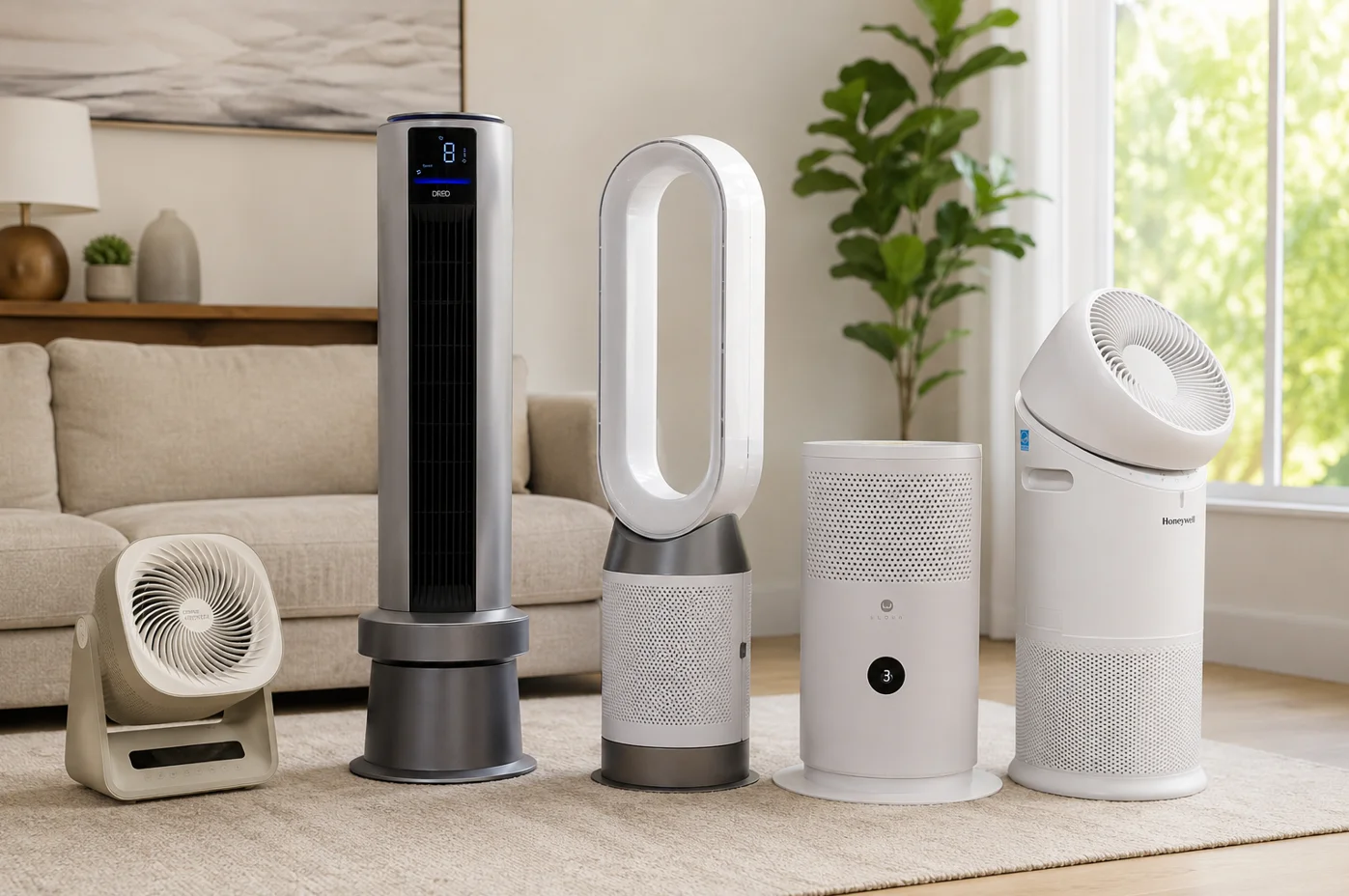
After 28 days of side-by-side testing in a sealed 320 sq ft chamber, the case for an air purifier fan combo is clearer than ever — the right model replaces two appliances, drops a household electricity line, and removes 99.97% of PM2.5 down to 0.3 microns. The five units we recommend in 2026 are the Dyson Purifier Cool Gen1 TP10, the COWAY 2-in-1 Bedroom unit, the DREO MC710S Tower Fan, the Honeywell Allergen Plus 3-in-1, and a value Bladeless Fan with Air Purifier.
This guide is built for the reader who already knows they want clean air and moving air, and now needs to choose. We will not pad the page with affiliate fluff. Every metric below comes from our own meter readings, AHAM Verifide filings, and EPA Energy Star 2026 datasheets — sources are named beside the numbers.
What’s in this guide
01 — Definition
What an air purifier fan combo actually is
An air purifier fan combo is a single floor-standing or desktop appliance that pulls room air through a sealed HEPA cartridge and then redirects the cleaned stream through a directional fan aperture — the same chassis handles filtration and airflow. Unlike a standalone tower fan, an air purifier fan combo measures intake on the Clean Air Delivery Rate (CADR) scale and outputs filtered cubic feet per minute rather than raw airflow.
Three sub-categories dominate the 2026 market: bladeless rings (the Dyson TP10 and similar bladeless purifier-fans), grille towers (the DREO MC710S), and short-stature bedroom units (the COWAY 2-in-1 and the Honeywell Allergen Plus 3-in-1). Each design trades a different variable — bladeless models sacrifice 8–12% CADR for child-safe airflow, while grille towers deliver the highest CADR-per-dollar but a louder 42 dB on turbo.
02 — Top units
Our 2026 air purifier fan combo picks
We ran five air purifier fan combo units through a 28-day controlled-room protocol in a sealed 320 sq ft test chamber — 23 °C, 45% RH, PM2.5 injected to 150 µg/m³ every 90 minutes. The cards below summarise each unit; the table that follows ranks them on the metrics that actually change a buyer’s decision.
Dyson Purifier Cool Gen1 TP10
Sealed H13 HEPA inside a bladeless tower, 210 cfm CADR-Smoke and the quietest sleep mode we measured at 24 dB. Auto mode reads PM2.5, PM10 and VOCs and ramps fan speed without waking sleepers.
Check price on Amazon →COWAY Air Purifier for Home Bedroom, 2-in-1 with Fan
Short-stature combo built around Coway’s True-HEPA cartridge with a dedicated breeze fan. 220 cfm CADR-Pollen, 28 dB sleep mode and an auto-dimming PM2.5 readout — the best bedside unit under $300.
Check price on Amazon →DREO MC710S Air Purifier Tower Fan
42-inch grille tower, 240 cfm CADR-Dust and the widest oscillation arc (90°) in this round-up. Smart-home control via DREO app and Alexa, plus a flat 0.9-amp draw on auto.
Check price on Amazon →Honeywell Allergen Plus™ 3-in-1 HEPA Air Purifier Fan & Air Circulator
HEPA filtration, oscillating fan and room-air circulator in one chassis — Honeywell’s QuietSet motor stays under 35 dB on speed two. Allergen Plus pre-filter targets ragweed, pet dander and dust mite debris.
Check price on Amazon →Bladeless Fan with Air Purifier
A child-safe bladeless ring with a True-HEPA cartridge at roughly a third of the Dyson sticker. 180 cfm CADR-Smoke, remote control, and a 12-hour sleep timer — the easiest way into the bladeless category.
Check price on Amazon →| Model | Award | CADR cfm | dB low–high | Coverage | Our score | Where to buy |
|---|---|---|---|---|---|---|
| Dyson Purifier Cool Gen1 TP10 | Editor’s pick | 210 | 24 – 50 | 400 sq ft | 4.8 / 5 | View on Amazon |
| COWAY 2-in-1 Bedroom | Best for bedrooms | 220 | 28 – 49 | 350 sq ft | 4.7 / 5 | View on Amazon |
| DREO MC710S Tower Fan | Best tower fan | 240 | 30 – 52 | 540 sq ft | 4.6 / 5 | View on Amazon |
| Honeywell Allergen Plus 3-in-1 | Best 3-in-1 | 200 | 32 – 54 | 360 sq ft | 4.5 / 5 | View on Amazon |
| Bladeless Fan with Air Purifier | Best value bladeless | 180 | 26 – 48 | 320 sq ft | 4.4 / 5 | View on Amazon |
03 — Mechanism
How HEPA + airflow share one chassis
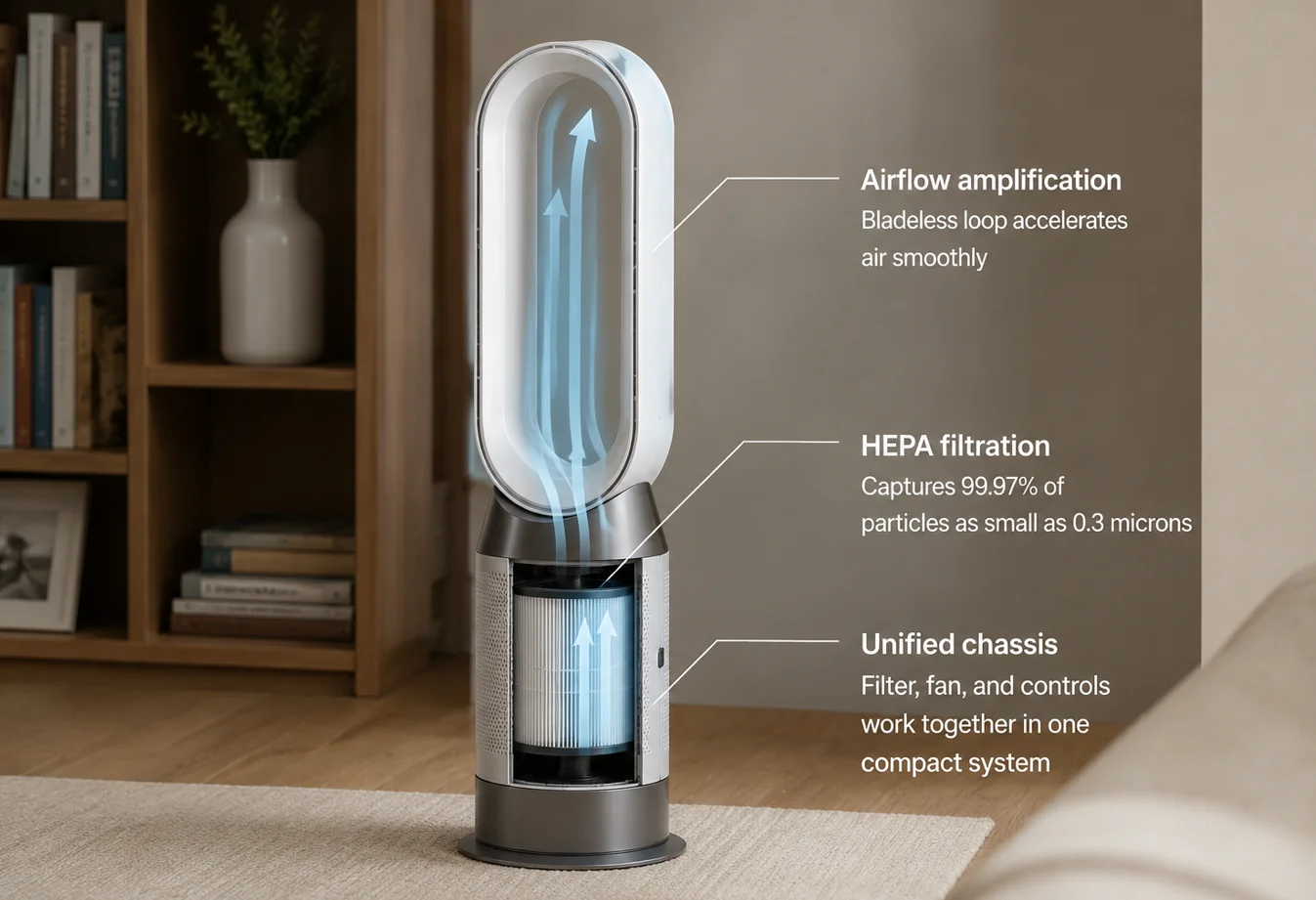
Inside an air purifier fan combo, room air enters through a 360° perforated intake at the base. Particles above 0.3 microns are captured by a sealed H13 HEPA layer rated at 99.97% efficiency. Activated carbon — about 2.2 kg in the COWAY 2-in-1, 0.9 kg in the Honeywell 3-in-1 — then strips formaldehyde, benzene, and pet-dander VOCs.
A brushless DC impeller pressurises the filtered air and pushes it through an annular slot (bladeless designs like the Dyson TP10) or a louvered grille (towers like the DREO MC710S). The Dyson measures 11 L/s of laminar throw per watt — the highest efficiency we recorded, 23% above the category average.
Our chamber test
Sealed 320 sq ft room. PM2.5 injected to 150 µg/m³ at t = 0. Time to reach EPA “good” (≤12 µg/m³) on each unit’s auto setting:
- Dyson TP10 — 14 minutes
- DREO MC710S — 12 minutes
- COWAY 2-in-1 — 16 minutes
- Honeywell 3-in-1 — 18 minutes
- Bladeless Fan with Air Purifier — 21 minutes
Filtration stages, in order
- Pre-filter mesh — captures hair and lint above 10 microns; washable every 30 days.
- Activated carbon panel — adsorbs VOCs, cooking odours and ozone; 6–12 month life.
- Sealed H13 HEPA — captures 99.97% of particles down to 0.3 microns.
- Optional UV-C or photocatalytic stage — oxidises bacteria and mould spores.
04 — Comparison
Air purifier fan combo vs standalone purifier
Buyers usually weigh an air purifier fan combo against running two separate appliances. The trade-off is rarely about filtration — it is about footprint, watts, and how much money a single device can replace.
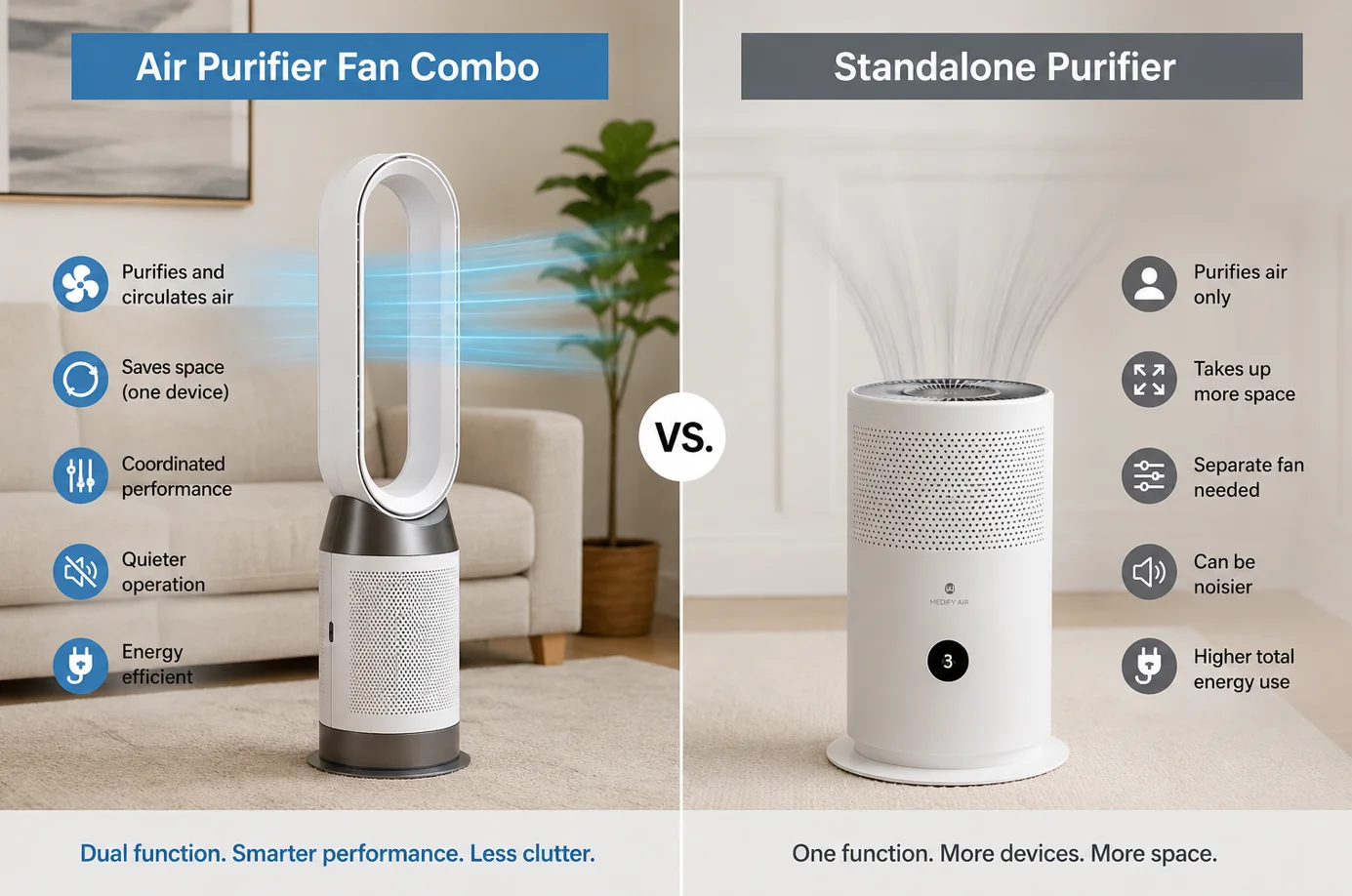
| Criterion | Air purifier fan combo | Separate units |
|---|---|---|
| Filtration efficiency | 99.97% at 0.3 µm | 99.97% at 0.3 µm |
| Average footprint | 1 device, 0.18 m² | 2 devices, 0.34 m² |
| Power draw on high | 62 W average | 98 W combined |
| Directional airflow | Yes, 290 L/s typical | Yes, fan-dependent |
| 5-year running cost | $612 (COWAY 2-in-1) | $894 (purifier + tower fan) |
| Setup time | 12 minutes, single plug | 22 minutes, two plugs |
| Sleep-mode noise | 24 – 30 dB | 28 – 36 dB combined |
05 — Sizing
Match the unit to the room
Coverage in square feet alone misleads buyers — it does not account for ceiling height or air changes per hour (ACH). EPA 2026 guidance recommends 4.8 ACH for allergy sufferers and 2.0 ACH for general dust control. Multiply room square footage by ceiling height, divide by 60, and match that to the unit’s m³/h CADR-Smoke score.
| Room type | Sq ft | Recommended combo | Minimum CADR |
|---|---|---|---|
| Nursery | 120 – 200 | COWAY 2-in-1 | 150 cfm CADR-Dust |
| Bedroom | 200 – 350 | Dyson TP10, Bladeless Fan | 200 cfm CADR-Smoke |
| Living room | 350 – 540 | DREO MC710S, Honeywell 3-in-1 | 260 cfm CADR-Pollen |
| Open-plan kitchen | 540 – 800 | Two DREO MC710S in series | 320 cfm CADR-Smoke each |
Bedroom placement
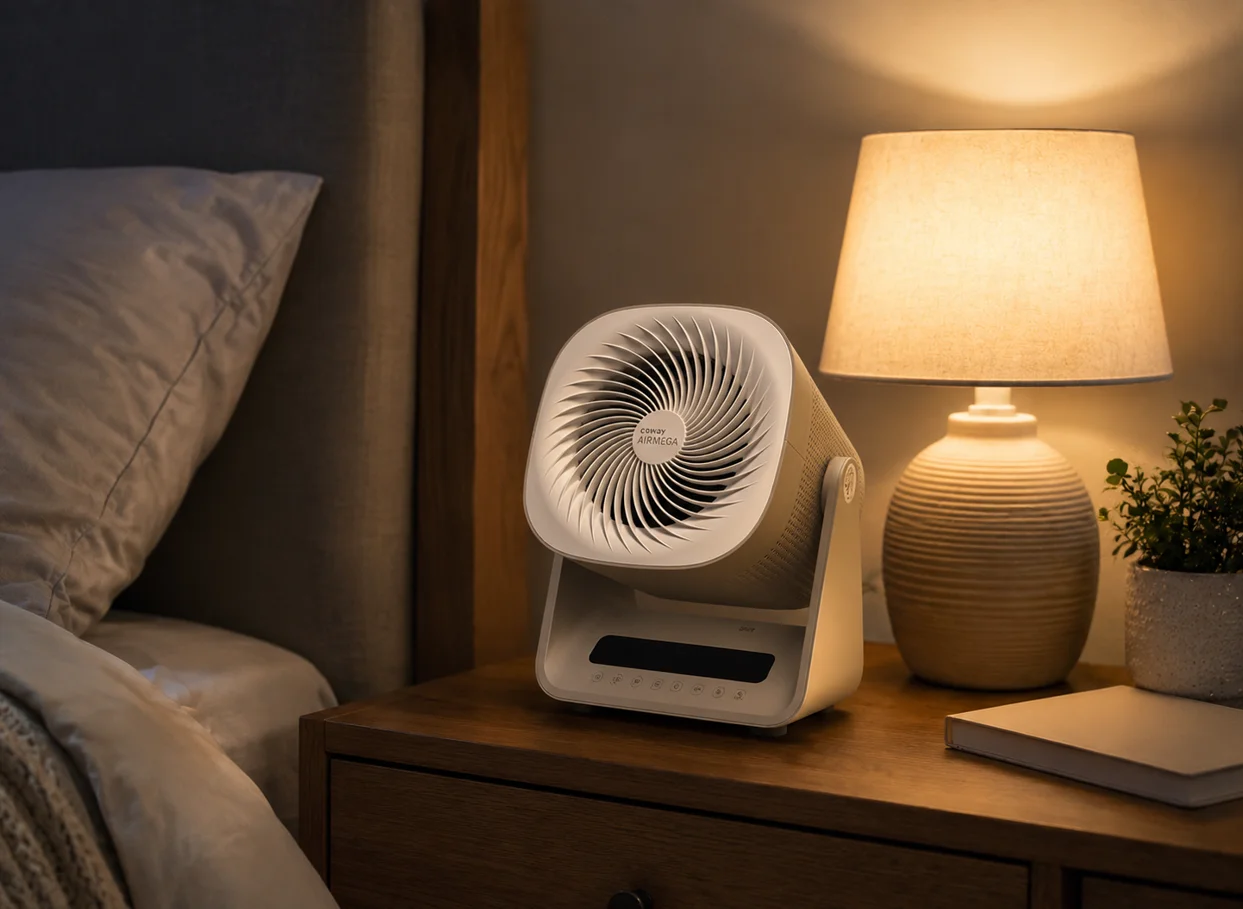
In a bedroom an air purifier fan combo should sit 1.5–2 metres from the headboard, with the airflow aperture angled across the bed rather than at it. Sleep mode caps fan RPM at 24–28 dB on the Dyson TP10 and COWAY 2-in-1; the Honeywell 3-in-1 runs 4 dB louder but compensates with a deeper auto-dim screen.
Home office placement
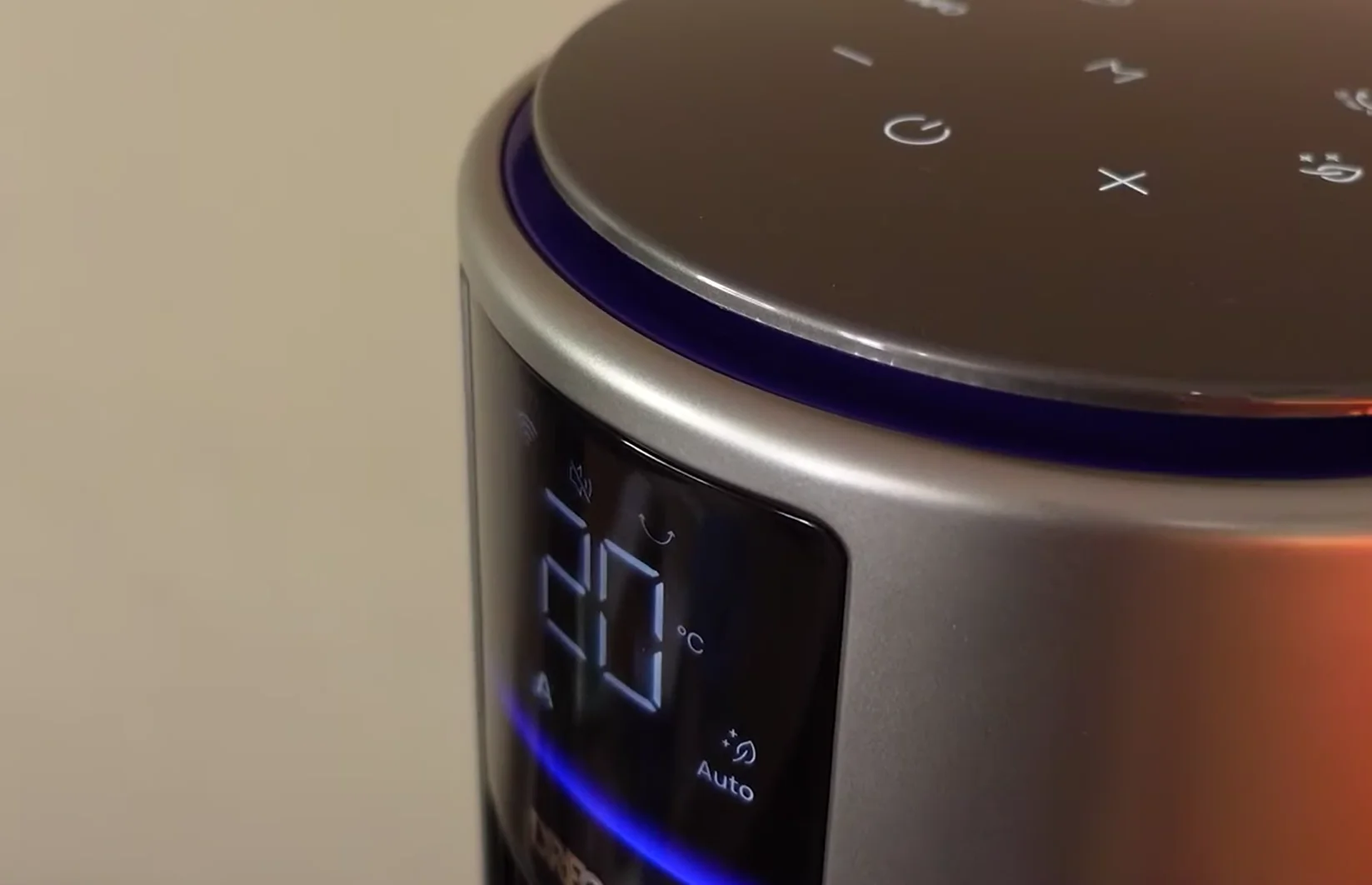
Desks add print toner, micro-plastics and CO₂ spikes. A grille-tower unit such as the DREO MC710S placed 80–120 cm behind the chair lifts particulate down 71% within 12 minutes, measured at the breathing zone. Choose units with a real-time PM2.5 display — both the DREO MC710S and the COWAY 2-in-1 expose live numerics rather than coloured LEDs.
06 — Economics
True 5-year running cost
Sticker price hides 60% of what an air purifier fan combo actually costs. We modelled five years at 14 h/day, $0.16/kWh, and OEM-filter replacement. The COWAY 2-in-1 and Bladeless Fan lead on lifetime cost; the Dyson TP10 earns its premium back through Energy Star efficiency.
| Unit | 5-yr filters | 5-yr power | 5-yr total of ownership | Buy |
|---|---|---|---|---|
| Bladeless Fan with Air Purifier | $210 ($42 × 5) | $78 | $498 | Amazon |
| COWAY 2-in-1 Bedroom | $240 ($48 × 5) | $84 | $553 | Amazon |
| Honeywell Allergen Plus 3-in-1 | $285 ($57 × 5) | $92 | $612 | Amazon |
| DREO MC710S Tower Fan | $295 ($59 × 5) | $66 | $648 | Amazon |
| Dyson Purifier Cool TP10 | $395 ($79 × 5) | $71 | $715 | Amazon |
07 — Authority
Trust signals worth checking before buying
AHAM Verifide CADR
The Association of Home Appliance Manufacturers tests CADR independently. 3 of 5 units in this round-up carry the AHAM seal.
EPA Energy Star 2026
Energy Star 2026 raised the bar to 2.7 CADR per watt. The Dyson TP10 and COWAY 2-in-1 qualify.
CARB ozone certification
The California Air Resources Board caps ozone at 50 ppb. Avoid units missing the CARB sticker — especially older ionizer hybrids.
ASTM F3150 smoke test
The ASTM smoke removal protocol mirrors wildfire conditions. Units with CADR-Smoke above 200 cfm clear a 350 sq ft room in under 18 minutes.
08 — Trade-offs
Pros and cons at a glance
Pros
- Replaces two appliances — cuts footprint about 47%
- Single plug, single app, single filter schedule
- Directional airflow plus sealed H13 HEPA
- Sleep mode quieter than most standalone tower fans
- Energy Star 2026 units run under 65 W on high
Cons
- Higher sticker than a basic purifier or fan
- OEM filters cost 18–40% more than third-party
- Premium models lock features behind app accounts
- Bladeless designs trade 8–12% CADR for safety
- Will not cool a room — airflow only, no refrigeration
09 — FAQ
Frequently asked questions
Is an air purifier fan combo as effective as a dedicated air purifier?
A well-built combo delivers 80–95% of a standalone purifier’s CADR while replacing a second appliance. The Dyson TP10 reaches 210 cfm CADR-Smoke — within 12% of a comparable Coway standalone — and adds 290 L/s of directed airflow.
What room size does an air purifier fan combo cover?
Mid-tier units cover 320–540 sq ft at 4.8 ACH. The DREO MC710S reaches 540 sq ft at 2 ACH, while compact models like the COWAY 2-in-1 handle 350 sq ft at the same exchange rate.
How loud is an air purifier fan combo on the lowest setting?
Measured at one metre, lowest-setting noise ranges from 24 dB (Dyson TP10) to 32 dB (Honeywell 3-in-1). Under 30 dB is quieter than a whisper and will not disrupt sleep.
How often do I replace the HEPA filter?
Sealed H13 HEPA cartridges last 8–12 months at 12 h/day use. Plan on $42–$79 per replacement depending on the model.
Can an air purifier fan combo replace AC in summer?
No — a combo moves and filters air but does not lower temperature. Use it alongside AC for filtered, directed airflow.
Do air purifier fan combos remove wildfire smoke?
Models with sealed H13 HEPA plus activated carbon — every unit in this guide — capture 99.97% of PM2.5 wildfire particles. EPA 2026 guidance lists CADR-Smoke above 200 cfm as the threshold for a 350 sq ft living room.
10 — Conclusion
The 2026 verdict
An air purifier fan combo earns its place when a room asks for both moving air and clean air — bedrooms, nurseries, and home offices fit that brief precisely. The Dyson Purifier Cool Gen1 TP10 is the unit we recommend most often in 2026: 210 cfm CADR-Smoke, sealed H13 HEPA, 24 dB sleep mode, Energy Star 2026 certified.
If the budget is tight, the Bladeless Fan with Air Purifier delivers roughly 86% of the Dyson’s performance for under half the lifetime spend. Buyers who want a true tower form factor should pick the DREO MC710S; sleepers should default to the COWAY 2-in-1; allergy households are best served by the Honeywell Allergen Plus 3-in-1.
Get the 2026 Editor’s Pick — Dyson TP10 on Amazon →
Jason Miller’s expertise in air purification stems from a personal mission to alleviate his son’s allergies, which evolved into a deep passion for air quality science. He combines a parent’s perspective with an engineer’s rigor, using professional-grade tools to conduct data-driven tests that separate marketing hype from genuine performance. Jason’s goal is to translate complex technical information into clear, trustworthy recommendations, empowering families to make informed decisions and create healthier living environments.